


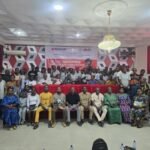






The VC, Prof. Offiong Offiong (right), presenting a memento to the Inaugural lecturer, Prof. Affiong Joseph Henry.
By Anietie Akpan
The 154th Inaugural Lecturer of the University of Calabar ( Unical), Prof. Affiong Joseph Henry has called for the utilization of local livestock breeds to enhance food security, stating that Nigeria is richly endowed with diverse indigenous livestock and poultry breeds that can be leveraged to improve the country’s food situation.
She made the call at the Godswill Akpabio International Conference Centre while delivering the institution’s inaugural lecture on the topic, ” Unlocking Potential: The Interplay of Genes, Environment And Phenotype in Animal Breeding And Sustainable Livestock Production”.
In a release from the Information Unit of the University, she said, indigenous livestock and poultry breeds, are carriers of unique genotypes suitably adapted to the different agro-ecological zones, stressing that, they hold the key to unlocking the country’s livestock potential and contributing to local and global food security.
Affiong, a Professor of Animal Breeding and Genetics emphasized that tapping into the potential of these indigenous breeds can have a significant impact on Nigeria’s food security, noting that they can be bred and improved upon to increase productivity and meet the growing demand for animal protein.

This, she noted, requires concerted efforts to conserve, improve, and utilize these genetic resources, and urged the government and stakeholders to prioritize the development of the livestock sector.
She also stressed that government initiatives and plans towards transforming the livestock sector must be all-inclusive and gender sensitive, cutting across the different value chains and producers.
The Don highlighted the need for incentives to be provided to all key players who are custodians of animal genetic resources to ensure conservation of indigenous species and their improvement.
The inaugural lecturer emphasized the importance of being mindful of the environmental impact of human activities, acknowledging the vital role the environment plays in sustaining animal production.
She also advocated for the adoption of genome editing technologies, but stressed the need for regulatory guidelines to ensure precise genetic modification and introduction of beneficial alleles in animal production.
Prof. Affiong also recommended the adoption of innovative phenotyping approaches, such as automated sensor-based measurements, image analysis, and spectral technologies, for effective large-scale phenotyping in livestock.
The Vice Chancellor of Unical, Prof. Offiong Efanga Offiong, commended the inaugural lecturer for delivering a comprehensive and insightful lecture, noting that it was a significant contribution to the field of animal science.
“I am impressed by the lecturer’s emphasis on the importance of harnessing the potential of indigenous livestock breeds to improve food security in Nigeria.
“This is a timely message, and I believe it will resonate with all stakeholders in the agricultural sector”, he said.
Prof. Offiong also used the occasion to call on agriculturists and those specialized in livestock to come to him to cross-fertilize ideas on how to revive the Unical farm, saying, “Let us work together to make the Unical farm a model for others to emulate.
” I invite all interested individuals to come and share their expertise with us, and together, we can make a difference in the agricultural sector.”
The well- attended lecture featured the presentation of a memento to the Inaugural lecturer by the Vice Chancellor.