









By: Celestine Mel
If I were appointed Chairman of INEC today, I would discharge the mandate of that office with unimpeachable fidelity, delivering a credible election without equivocation or compromise. My past or present political preferences, including any prior support for associates within the APC, would not encumber that responsibility. And if confronted with my digital footprint, positions once articulated or opinions previously advanced, I would acknowledge them without reservation. They are intrinsic to my constitutional rights as a citizen.
The act of supporting a candidate is neither aberrant nor improper; it is an inalienable feature of democratic participation. Indeed, citizenship presupposes the freedom to hold and express political preferences. The true test, however, lies in one’s capacity, upon assuming public office, to transcend antecedent affiliations and execute assigned duties with demonstrable impartiality and integrity.
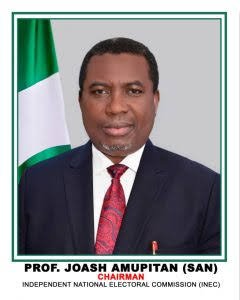
It is precisely at this juncture that Prof. Amupitan’s response becomes problematic. His categorical denial of what appears to be empirically verifiable has introduced an avoidable dissonance into the public space, thereby eroding confidence in both his person and the institution he represents. In a digital era where evidentiary trails are neither obscure nor easily extinguished, denial ceases to function as a viable defence and instead amplifies scrutiny. A prompt and candid acknowledgement might well have circumscribed the issue, preserving both reputational capital and institutional gravitas.
More critically, the manner in which the matter has been managed invites legitimate inquiry into questions of judgment and underlying intent. It conveys, rightly or wrongly, the impression of a posture unprepared for forensic interrogation, akin to a situation where exposure was neither anticipated nor adequately contemplated. One is reminded of the familiar metaphor of a child with a hand caught in a cookie jar, not merely confronted with discovery, but visibly unready for its consequences. In the realm of public stewardship, such optics are consequential. The protraction of what should have been a straightforward clarification only deepens skepticism and lends credence to avoidable conjecture.
Having undertaken a careful review of publicly available data myself in the last few hours, the convergence of identifiers, namely the X account, the associated email address, and the linked telephone number, points with considerable clarity to Prof. Amupitan. The reasonable inference, therefore, is that the posts in question originated from him.

This, in itself, need not have been fatal. What renders the situation regrettable is not the prior expression of personal views, but the subsequent reluctance to reconcile with them in a transparent manner. At this juncture, the imperative shifts from personal defence to institutional preservation. The continued occupancy of the office under such a cloud risks attenuating public trust in the very processes the institution is mandated to safeguard. Accordingly, the only course that aligns with the highest traditions of public accountability may be for him to step aside. For in public office, legitimacy is not sustained merely by legality, but by the enduring confidence of the governed.
Sadly!