




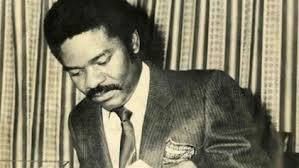
Late Dele Giwa.
By Sam Akpe
Finally, here it is! Dele Giwa, the late journalism icon, is back—in prose. It’s a breaking news! The Dele Giwa Journalism Research Centre—a digitalised archive that features the works of the late journalism legend, is now available.
The online construct is a research hub exclusively dedicated to exhibiting Dele Giwa’s intellectual contribution to the growth of the society—a confirmation of the unceasing impact of his journalistic exploits.
The virtual Centre is still work-in-progress. But since my first visit, I have not been able to take my eyes off the screen. Daily, the site gets better and juicier in contents, as freshly-minted and appetising updates keep making their entry.
The website—a friendly ecosystem devoid of advertorial distractions—is designed to host everything—almost everything—written by Dele Giwa since he arrived Nigeria from the United States of America in late1979.

For example, his first column in the good old Daily Times, headlined: Golden Fleece—I Think I Got It, is as juicy in context and style as though it was published this morning. The story captures the day he arrived the US, his academic pursuits, work experience, and his return to Nigeria.
For the post-1986 generation of Nigerians, the name Dele Giwa might sound strange, and even archaic. Someone is likely to ask: Who the heck was he? This is because some may not have heard of him or read any of his articles.
Prior to Dele’s unnatural death in 1986, internet was still an unheard-of phenomenon waiting to be invented and used across the world. In its absence, publication, storage and retrieval of information was comparatively analogue. Dele was a pre-internet happening in Nigeria.
Until his return to Nigeria in 1979, even among the old generation journalists, the name Dele Giwa made no meaning to them in spite of the fact he had spent more than four years as a news assistant at the New York Times—regarded as the world’s most influential newspaper.
Therefore, the web domain is constructed to honour his life, intellect, and legacy. More than that, it is meant to preserve the memories of Dele—as he was known by friends and colleagues—because he remains indisputably, one of Nigeria’s most brilliant and courageous journalists.
The website comes as a relief to most of his colleagues who for 40 years—since his death—had tried every option, within limited resources, to keep his memory alive by publishing his acclaimed columns which covered his tour of duty at the Daily Times, the Concord, and Newswatch magazine.
In 1997, Nyaknnoabasi Osso, the pioneer Newswatch librarian, who is regarded as trusted custodian of Dele’s collection of published columns, had experimented on a book entitled: Parallax Snaps: The Writings of Dele Giwa. It was not a success story. In his autobiography: Osso narrates how he got to know Dele through Ray Ekpu who was Dele’s close friend, long before Newswatch started.
This reporter learnt that it was about a year ago that Nyaknnoabasi started discussions with Dele’s first son, Billy, on the need to preserve and promote Dele’sintellectual inheritance by creating an open podium for research, historical documentation, and scholarly engagement.
Dele’s family was excited by the idea. With Billy bankrolling the process, the Biographical Legacy and Research Foundation (BLERF)—a global information powerhouse founded by Nyaknnoabasi—was endorsed to power the innovation which today is gradually gaining a world-wide attention.
The Centre, according to the mission statement of the founders, is fully dedicated to advancing the doctrines of ethical journalism anchored on truthfulness, integrity, and courage while inspiring future generations to pursue excellence and principled reporting.
Before someone wonders why I am celebrating the innovation, let’s briefly look back at who Dele was and what he means to journalism. I never met Dele one-on-one. I was too insignificant in journalism at the time he flourished in the profession, after his return from New York Times to Nigeria’s Daily Times.
When he accepted the challenge of returning to Nigeria in 1979, he did so armed with a rock-solid professional credibility which he earned at the New York Times. He was aware that not much had changed between when he left home and when he returned.
In his words, he knew that armed robbers were still sending notices of their visits to their victims. Public water supply was non-reliable. Electricity still flickered. Travelling by road was like being hell-bound. Still, he was persuaded by Dele Cole and the late Stanley Macebuh to return home.
My distant knowledge of Dele started during his ebbing days at the Sunday Concord, through his weekly column. Later in 1984 when I found myself in journalism school, my lecturers talked about him and Ray Ekpu with unhidden deference. That was when Newswatch Magazine came on the scene.
Required by different instructors to do assignments which involved mass media content analysis, I found myself drawn to Dele’s writings. I discovered that his journalism was awe-inspiring—bold, scholarly at times, truthful, intellectually exciting, and stylishly yummy.
Even as a student reporter at the then Nigerian Chronicle where I did my internship, though I hardly understood the implied meanings of most of his thoughts captured in his weekly striking prose, I desired to write like Dele—I am still trying to.
From my findings, it was clear that the moment Dele appeared in the Nigerian journalism scene, something shifted. He was refreshing and unpretentious. Though disdained by the system, he was adored and even worshipped by others.
His column in the Daily Times, where he spent about a year, was a must-read. He was professionally tempestuous, because as they say in the local parlance, he was always shaking the table. He became a navy seal in the infantry squad—tough, demanding and fearless.
It was and still remains a wonder how Dele and Uncle Ray lasted so long at the Concord. At Newswatch, Dele led a pack of well-tested and dazzling news hunters. His was a generation of journalistic intellectual poster boys who paraded professional credentials that separated them from mere run-of-the-mill reporters.
The team reinvented journalism with excellent investigative reportage. Collectively and individually, they tried to be super ethical—disciplined, focused, and even rich. They pioneered the era when journalists started driving Mercedes Benz cars.
Analysis of Dele’s journalism style exposed the fact that he never liked satire—an evasive literary device which, for fear of repercussions, mocks a subject through indirect name-calling and mud-splashing. Dele loved to say what he wanted to say directly and fearlessly.
His journalism was designed to embody what the profession was intended to be—ethical and revolutionary. When you think about Dele’s journalistic style, you think boldness, think self-confidence, think facts, think ethical adherence, think audacity, and think influence.
Those who did not like Dele’s brand of reporting—and tried to label him the bogey man of Nigerian journalism—were actually in love with his style, even when they were targets of his unsparing narratives. His words had enormous weight. He chose them carefully.
Dele did not seem to have permanent friends. This is however based on a distant perception. He had an enduring vision of practicing rule-based journalism without emotionally-induced distraction based on friendship. To him, what was right was right, and what was wrong was wrong—no strings attached.
On October 19, 1986, a parcel was delivered to Dele’s home. His son received it from the strange delivery man and took it to him. It was a deadly gift item. Dele must have thought the parcel contained some document that would give Newswatch another exclusive story.
Seated with Dele in his study was the London correspondent of Newswatch magazine, Mr. Kayode Soyinka, who was on a visit to Nigeria. Kayode has given a brief insight of what unfolded that moment in his memoir: Born Into Journalism—Memoir of a Newspaper Reporter
Oddly, Dele was instructed by the sender, in writing, to open the pack by himself. With the parcel placed on his lap, he tore it open. Instantly, a loud explosion shook the entire building. Kayode narrowly survived to tell the story. Dele did not.
They killed him and created an evil metaphor: here was a man who stormed Nigerian journalism scene with a detonated intellect and uncommon boldness expressed in his unputdownable prose, only to be bombed to death through an uncommon device.
There is a spine-chilling saying among the United States elite military group called Navy Seal: “live fast, die young, and leave (behind) a good-looking corpse.” Dele lived fast, died young, and left behind an impeccable professional integrity.
It would demand a study in a field beyond human psychology to establish how, at age 39, when he died, Dele had achieved so much in his chosen career that those who tripled his age would never dream of in any discipline. He was still climbing when they cut him down.
His death signalled an increase in organised death sentences against journalists across the world. With tears in our eyes, let’s migrate to delegiwacentre.com,for the tasty contents that stood him out of the crowd among his contemporaries.
Akpe is a Journalist, writes from Abuja.