






By Dianabasi Effiong
It is not in doubt that societies that celebrate hate, fostered by religion, tribe, and politics, hardly free themselves from insecurity.
On Nigeria’s highways, in the creeks, the maritime domain, farmlands, homes, worship centres, markets, the transport sector, media houses, journalism practice, and across various professions, insecurity has been challenging public peace, unity, and progress significantly.
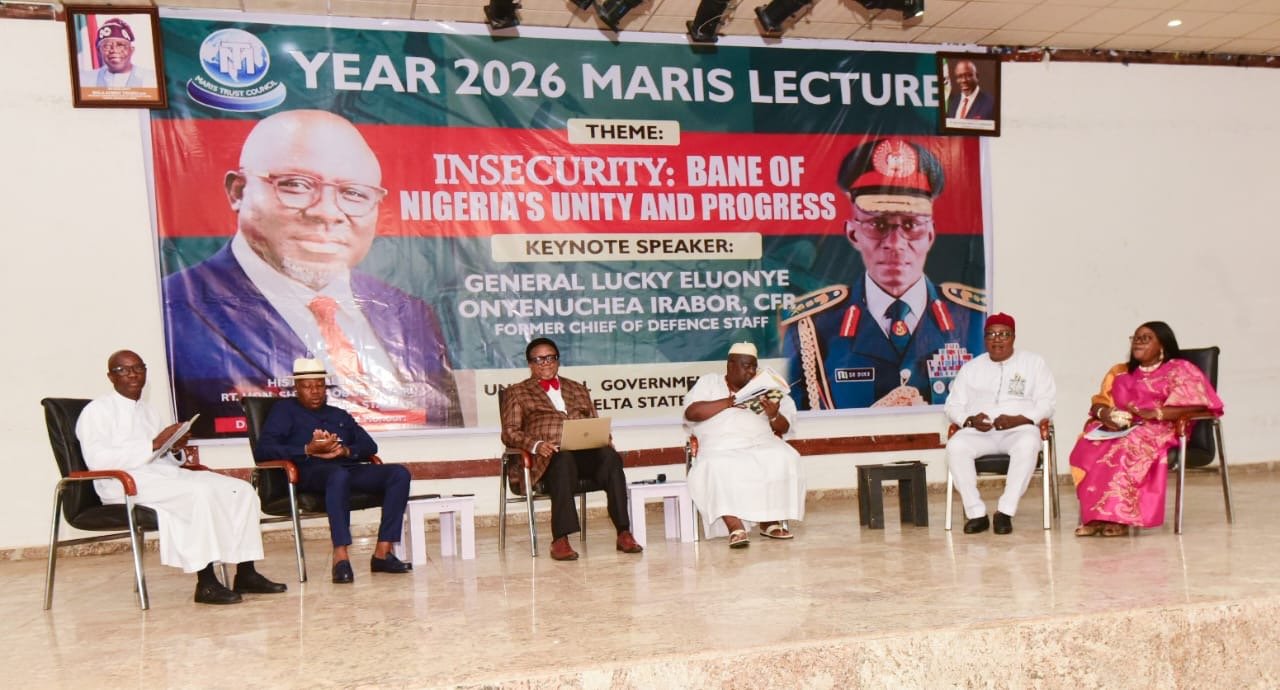
Worried by these, a Delta State-based privately-owned institution, the Maris Trust Council (MTC), rolled out its 7th Maris Annual Public Lecture series under the theme: “Insecurity: Bane Of Nigeria’s Unity and Progress”, on April 1, 2026, in Asaba.
For retired Gen. Lucky Irabor, the former Chief of Defence Staff, Nigeria, in 2026, stands at a crossroads where “our greatest strength, human capital and diversity, has been held hostage by a fragmented security landscape.”
According to him, insecurity is no longer merely a Police or Military problem; it has now become a hydra- headed monster that inhibits Nigeria from attaining the United Nations Sustainable Development Goals.

According to Irabor, who delivered a keynote lecture at the occasion held at Unity Hall, Government House, the import of the trauma that insecurity has wreaked on the Nigerian psyche may not be fully comprehended by most citizens.
He said that beyond the trauma, much effort would be required to heal the nation.
Irabor recalled, “My troops had just moved into a town we had newly liberated from the grip of Boko Haram. You would have expected the roar of celebration. Instead what we saw was a profound, heavy silence. As we walked through the dusty streets, we encountered a group of elderly men and women who had lived under the insurgency’s shadows for years. They did not cheer; they simply stared, their eyes reflecting a deep-seated uncertainty. It was the look of a people who had forgotten what it felt like to be seen by their own government, a people whose ‘progress’ had not just stalled, but had been violently reversed. I realised at that moment that reclaiming the land was the easy part. The real challenge, the true ‘conundrum’, was reclaiming the trust and future of the people living on it. That ‘loud silence’ I heard in that village is what I have come to term as the “Conundrum of Silence” or ‘defeat in the victory’.
“Metaphorically, imagine the story of Jacob’s daughter Dinah, raped, and two of her brothers went and exacted justice, even though they went overboard. But imagine Dinah was repeatedly raped, and though the brothers had the capacity and could have saved her, they never came around to lifting a finger until after several years. The result is a silence of broken trust; deep trauma and perhaps generational psychological scars on the populace and even the military liberators.
“The silence in the North East is the same silence we hear in those abandoned farmlands across the Middle Belt and in the villages in the South East where for years now, they have been compelled by non-state actors to sit at home every Monday. It is a silence that signals not just the erosion of trust in our national institutions but the erosion of our national unity itself.”
Irabor said that such silence, through discourse and positive action as reflected by the ‘blunt’ theme of the 2026 Maris Lecture, could be turned into a “symphony of progress”…to quickly heal the wounds of the past and ensure the ‘scars’ become the foundation of a prosperous and secure Nigeria.
Irabor said: “Insecurity is not merely a security challenge; it is the single greatest impediment to Nigeria’s cohesion and attainment of the SDGs.
“Without peace, there can be no sustainable development, a truth echoed repeatedly in the UN reports and Africa’s Agenda 2063.”
He added that though Nigeria’s insecurity is systemic, multi-dimensional, and self-reinforcing, Delta State could model a path forward.
He said that the state “should not remain as a peripheral oil- producing entity but strive to become a strategic and living laboratory where academia, business, and politics converge to model solutions that scale nationally.”
*Nigeria’s insecurity is geographically pervasive*
According to Irabor, a quick diagnosis of Nigeria’s insecurity landscape indicates that incidents are geographically pervasive with Boko Haram in the North East and its splinter groups continually “destabilising entire local government areas; banditry and kidnapping syndicates turning highways and farmlands into zones of predation in the North West; separatist agitation and unknown gunmen eroding state authority in the South East; and oil theft, pipeline vandalism, and cult-related violence persisting in the South South despite the laudable amnesty programmes of the Federal Government.
Quoting from data released by the National Bureau of Statistics (NBC) in its “Crime Experience and Security Perception Survey (CESP) 2024”, Irabor stated that the security situation in Nigeria between May 2023 and April 2024 was characterized by extremely high levels of violence and criminal activity, adding that “Nationwide, Ransom-driven kidnapping has become an industry.”
The NBC report on security perception within the period in focus also indicated that more than 600, 000 people were killed; more than two million people abducted (approximately 2,235,954); Nigeria’s paid more than two trillion Naira to kidnappers (approximately N2.23 trillion); average ransome paid per incident was approximately N2.67 million, 65 per cent of affected households resorting to payment; criminal activities were more prevalent in rural areas (1.6 million) compared to urban centres (567,850); while the North West region was the hardest hit by both killings and kidnapping, with 206,030 kings and more than 1.4 million kidnappings, followed by the North Central and North East regions respectively.
It also showed the escalation in the cost of security, with the ransom paid by citizens surpassing the budgets of several government ministries during the period, even as it further stated that a significant percentage of incidents were not reported to the Police due to a lack of trust or belief that no action would be taken.
*Root Causes of Insecurity*
Irabor said that causes of insecurity were more structural than cultural, the major ones including “youth unemployment, elite capture of resources, porous borders, and a security architecture remaining overly centralised and under-resourced.”
He added: “Unemployed but impressionable youths, driven by poverty and hunger and exacerbated by elite mismanagement of national resources, get easily recruited into criminal networks.
“These criminal gangs first find havens in rural areas because of the limited or absence of state institutions. They take advantage of our porous borders to link up and freely operate with international criminal networks to escalate their activities. With no consequences for their actions due to under-resourced security institutions, their impunity thrives.
“Incidents like this impact farmers…they cannot work their farms, traders cannot move goods, and parents keep children away from schools, the result is a vicious cycle of insecurity that breeds poverty, and that poverty breeds more insecurity.”
*Impact on National unity, progress, and sustainable development*
According to Irabor, two of Nigeria’s most precious aspirations, unity and progress, are impacted by insecurity.
“Starting with unity, Nigeria’s federal character was designed to manage diversity, yet insecurity has deepened the outward- pulling forces. Separatist rhetoric in the South East, farmer-herder clashes that pit the North against the South, and resource-control grievances in the Niger Delta have all intensified. When citizens in one zone live in perpetual fear while others appear insulated, the social contract frays. National integration, that elusive sense of “oneness, becomes performative rather than substantive.”
He said that without security, every other SDG collapses, while environmental sustainability is compromised.
“Oil theft in the Niger Delta has led to massive spills, destroying mangroves and fisheries. Banditry prevents deforestation and climate-adaptation projects in the North.
Without security, development is impossible.
“Without development, security cannot hold. In short, insecurity is not a parallel challenge to sustainable development; it is the primary obstacle. Nigeria cannot reach upper-middle-income status or meet its 2030 commitments while large swathes of territory remain ungovernable,” Irabor said.
*Framework for sustainable solutions*
Irabor said that defeating insecurity required what he called an integrated framework for sustainable solutions including a deliberate fusion of academia, business capital, and political leadership.
He said that Universities and think-tanks needed to move beyond diagnosis to actionable research adding that academia could decide to do longitudinal studies in the impact of community-led security architectures or investigate the geospatial mapping of security hotspots.
“From such detailed research should proceed tangible actionable points for business and political leaders.
“Universities in Delta State, in partnership with international institutions, could start a ‘Niger Delta Peace and Development Lab’ or whatever name it may be called, to generate data-driven policy options for the state government.
“The private sector could start investing in ‘secure growth zones’. Agro-industrial clusters in the Delta protected by public-private security partnerships, digital platforms for transparent oil tracking, and skills academies that convert idle youths into productive labour are ideas worth considering.
“Corporate social responsibility must evolve into strategic co-investment in resilience, not charity, but enlightened self-interest. When businesses see Delta State as a low- risk gateway to national markets, capital will follow peace,” Irabor said.
He also urged that, on the security front, the federal and state leaders in Nigeria should embrace a decentralised security (what he called ‘state police with federal oversight), and for governance, they should adopt a fiscal federalism that rewards performance with strong anti-corruption mechanisms that restore trust.
“Delta’s recent emphasis on unity offers a political model worth emulating,” Irabor said.
He added that “political elites across all zones in Nigeria must recognise that insecurity is not a regional problem but a national liability that threatens the very federation they govern.”
*Priorities for national security*
The retired former Chief of Defence Staff said that coordinated mult-level interventions “can transform insecurity from a chronic liability into a manageable challenge” that could foster unity and progress.
Irabor also said that implementing comprehensive security sector reforms that orchestrate governance improvements, economic diversification, technological innovation, and institutional strengthening could position Nigeria as a stable regional power.
He called for investments in advanced technologies like drones, satellite surveillance, and AI-assisted intelligence analysis tools, which could increase situational awareness, improve rapid response, and enhance targeting of criminal networks.
He said, “Now is the time for a national emergency proclamation on security. The security architecture must be seen as a single entity responsible for providing security and defence of the nation. Assessed equipment upgrades should be coupled with enhanced training for personnel to maximise operational effectiveness and reduce casualties during field operations. Reforms must factor in technology-enabled platforms. Integration of technology allows security forces to anticipate threats rather than react passively.”
He also called for community engagement; localised community policing initiatives that improve responsiveness and strengthen public trust; promoting economic opportunities; strengthening justice and rule of law; a forum for national reconciliation among the federating entities; and enhancing coordination of response agencies, for the overall defence and security of Nigeria.
Maris Lecture 2026: Oborevwori Rallies Citizens’ Active Participation In Tackling Insecurity As Irabor Blames Unresolved Political Crises
Also, Gov. Sheriff Oborevwori of Delta said that though government alone could no longer bore the burden of protecting lives and property, citizens ought to take a more active role in confronting unending violence in Nigeria.
He told participants at the 2026 Maris Annual Public Service Lecture in Asaba, that insecurity as an existential threat to national unity, adding that collective vigilance and cooperation between citizens and security agencies were now indispensable.
The Annual Lecture series – a platform to offer solutions to identified societal challenges holds every Wednesday before Easter Sunday.
The governor was represented by the Commissioner for Basic and Secondary Education, Dr Kingsley Ashibuogwu.
Oborevwori said, “Security is no longer the exclusive preserve of government.”
He also called for community-based policing and citizen intelligence as part of a broader security architecture.
The governor said his administration has been giving operational support for security agencies.
The lecture brought together policymakers, scholars, and security experts, many of whom echoed concerns that insecurity in Nigeria had outgrown conventional responses.
Similarly, the Chairman of the occasion, former Chief of Naval Staff, Admiral Dele Ezeoba (rtd), in his opening remarks lauded the Maris Trust Council for sustaining the annual lecture in honour of late Stella-Maris Egugbo.
He said that the series had unveiled various topics that had contributed to intellectual discourse as part of effort to address Nigeria’s challenge, adding that the 2026 theme was appropriate and moreso, delivered by Gen. Irabor, an intellectual.
He said that governance anywhere was intended to ensure security of lives and property.
Ezeoba said: “Security is everybody’s business to ensure safety as insecurity is absence of security”.
Expressing confidence on the keynote speaker, Gen. Irabor, he urged discussants to explore the lecture’s theme and proffer solutions to Nigeria’s security challenges.
He urged government to provide an environment that allowed for free enterprise and people’s liberty of movement, adding that when that was not prevalent, there could be a fundamental problem.
Additionally, the Secretary to the State Government (SSG), Dr Kingsley Emu, lauded the speaker, Gen. Irabor and the Chairman, Admiral Ezeoba for their contributions and recommendations as solutions to insecurity in the country.
He also said that the choices the youths make today exacerbate insecurity, adding that there was need to re-orientated the youths to understand that there has always been hardship.
He said that the state government had a mechanism in place and making efforts to accommodate, and educate the youths through various platforms including agriculture, commerce and various empowerment programmes which had been helping, significantly.
Discussants included Prof. Hope Eghagha of the University of Lagos; Chairman of Burutu LGA Friday Ofoke Warri; Rev. Fr. John Konyeke; Dr Rosemary Ogabu; the Moderator, Prof. Kemi Emina of Delta State University, Abraka, and former Director, DSS, Mr Mike Ejiofor (rtd).
The discussants, who deliberated on the lecture, raised concerns and defined the roles of government and other stakeholders to curb growing challenges posed by insecurity in the country.
On his part, Mr Fidelis Egugbo, Secretary, MTC and the Senior Special Assistant (Media) to Gov. Sheriff Oborevwori, thanked those who supported the MTC, adding that the lecture could be sustained further with the support by relevant stakeholders.
The annual lecture series was instituted to immortalise the late Stella-Maris Chukwufunimnenya Egugbo, a pupil and daughter of the Secretary, MTC, Fidelis Egugbo, who is also a knight of Saint John International and Proprietor, Maris Schools, Amachai-Okpanam, Delta.
Those who attended the lecture included Gen. Mike Ndubisi, who represented Rear Adm. Mike Onah as Father of the Day, Dame Princess Minnie Igbrude, Mother of the Day, Dame Princess Minnie Igbrude, the Coordinator, Tinubu Torchbearers Initiative (TTBI) in Delta (Mother of the Day), Dr. Mininim Oseji, Head of Service (HOS), Delta State, Phar. Dr. Paul Enebeli and his son, Chukwudi Enebeli (SAN).
Others are Hon. Uche Uraih, Ph.D., and his wife, Patricia, Hon. (Barr.) Sam Osasa, the Executive Secretary, Delta State Security Trust Fund, Sir Patrick Ejidoh, Mrs Florence Omoni Johnson, Dr. Festus Okubur, Rev. Fr. Andrew Mozia of the Catholic Mass Centre, Maris Schools, Okpanam, Hon. Anthony Chukwu, this writer, Mr Dianabasi Effiong – a stakeholder – who attended from Uyo, Akwa Ibom, top government officials, journalists led by Comrade Churchill Oyowe, Chairman, Nigeria Union of Journalists, NUJ Chapter, members of EXCOF led by Mr Sunny Edoge, Mr Dennis Media, Greg Ejohwomu, the civil societies, security experts, the Egugbos, among others from different walks of life.