







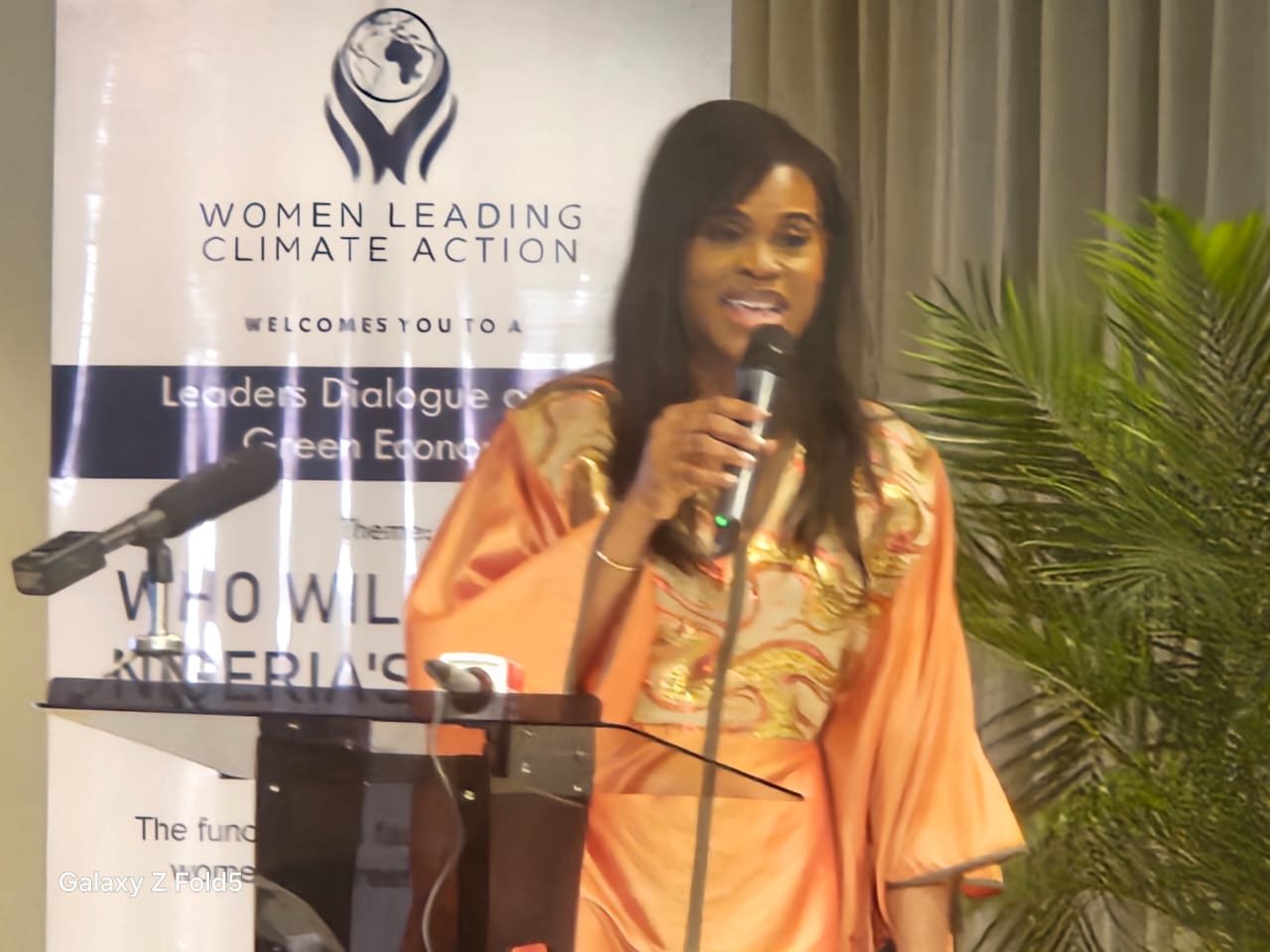
Founder, WLCA, Amanda Archibong-Doukouré during her presentation at the meeting.
By Anietie Akpan
Nigeria risks missing out on key economic opportunities under the African Continental Free Trade Area (AfCFTA) if urgent steps are not taken to support women-led climate businesses, stakeholders have warned.
The warning was stated by the Founder of Women Leading Climate Action (WLCA), Amanda Archibong-Doukouré, during a high-level green economy dialogue held in Abuja on Tuesday.
The event brought together policymakers, investors, development partners, and entrepreneurs to explore financing and trade pathways for women-led green enterprises.
Archibong-Doukouré stressed the need to align climate finance with grassroots enterprises driving real impact, noting that women remain largely excluded from formal investment pipelines despite playing a central role in the green economy.

“Women are building the green economy, but they are not shaping or accessing the capital that drives it,” she said, highlighting their dominance in sectors such as agro-processing, clean energy adoption, last-mile distribution, and circular economy systems.
She warned that failure to support women entrepreneurs with financing, capacity building, and market linkages would limit Nigeria’s ability to fully harness the benefits of the 1.3 billion-consumer AfCFTA market.
“If women entrepreneurs cannot access financing, capacity building, and market linkages, then that becomes a missed opportunity for the country,” she said.
Archibong-Doukouré noted that Nigeria has nearly 40 million micro, small, and medium enterprises, with almost half of micro-enterprises owned by women, yet faces an estimated $158 billion financing gap.
“The real question is, who is designing the system and who is it designed for?” she queried.
According to her, while Nigeria mobilises about $2.5 billion annually in climate finance, much of the funding is structured for larger, established firms with collateral, leaving early-stage women-led businesses excluded.
“The missing middle is where the opportunity lies,” she added, stressing that women-led enterprises are key to delivering scalable climate solutions at the community level.
Also speaking, the European Union Ambassador to Nigeria and ECOWAS, Gautier Mignot, said empowering women entrepreneurs is critical to Nigeria’s green transition and economic growth.
“Women are already central to this transformation,” he said, citing their strong presence in agriculture, informal trade, and local markets, despite their underrepresentation in finance and decision-making.
Mignot noted that women own about 42 per cent of MSMEs in Nigeria and account for nearly 40 per cent of newly established businesses, yet many struggle to scale due to limited access to capital and weak integration into value chains.
“If we leave aside these entrepreneurs and innovators, we lose at least half our capacity to advance the green economy,” he said.
Chairperson of the United Nations Sanitation and Hygiene Fund, Cecilia Akintomide, said Nigeria has demonstrated strong investor appetite for green finance but warned that women are not benefiting proportionately.
“The market is there, but women are not necessarily benefiting from it,” she said.
Akintomide identified barriers including limited access to education, unsuitable financing structures, and concentration of funding in sectors where women are less represented.
“We have to be intentional to ensure women are not left behind. Gender must be a mandatory component in financing and operations,” she said.
She also emphasised the need for appropriate financing instruments tailored to business stages, warning against offering loans to enterprises not yet positioned to manage them.
“Sometimes we’re giving loans to organisations that are not at the level where they can support loans. We have to ensure the right instrument fits the right stage of that business,” she added.
Stakeholders at the dialogue agreed that improving access to finance, strengthening capacity, and building inclusive investment pipelines are critical to unlocking the full potential of women-led climate enterprises in Nigeria.
The event also featured panel discussions and presentations from climate-focused businesses working across waste recycling, renewable energy, and climate-smart agriculture, with organisers pledging continued support through financing linkages and technical assistance.