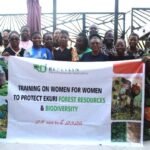








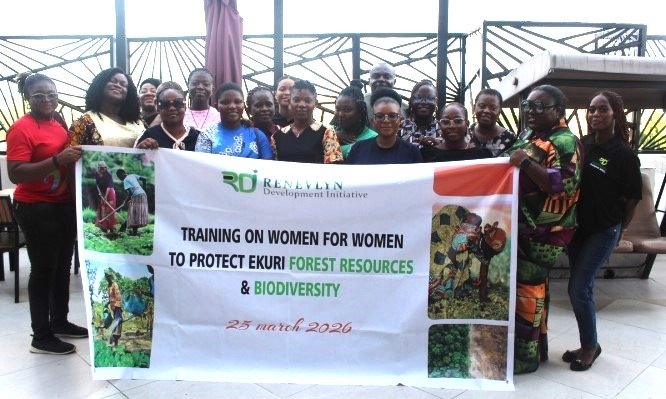
Participants any organizers
By Afiong Ndem
The Renevlyn Development Initiative (RDI) has trained women journalists and women from Ekuri communities in Cross River State on the impacts of illegal logging and climate-induced deforestation on livelihoods and biodiversity.
The training, themed “Women for Women to Protect Ekuri Forest and Biodiversity,” was held on March 25, 2026, in Calabar, bringing together journalists and women from affected communities.
RDI said the programme aimed to strengthen the capacity of women journalists to report effectively on how illegal logging affects women, while also connecting reporters with women on the frontlines to ensure their experiences receive adequate media coverage and policy attention.
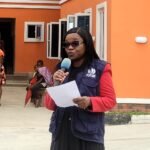
In her welcome remarks, RDI Project Officer, Linda Amadi, noted that while illegal logging in Ekuri forest has received media attention, the specific challenges faced by women are often overlooked.

She described the once-pristine Ekuri forest as now “a shadow of its former self,” adding that women, despite bearing the brunt of the socio-economic impacts,are rarely consulted in decision-making processes concerning the forest.
Citing data from Global Forest Watch, Amadi said Ekuri and its environs had lost over 540 square miles of tree cover as of 2024. She further alleged that more than 200 truckloads of timber leave the area daily, with local resistance often met with harassment by security personnel linked to logging operators.
According to her, women, mostly farmers who depend on forest resources for food and medicine, are increasingly forced to travel longer distances into the forest, exposing them to risks and hardship.
Speaking on “Reporting Women and Illegal Logging: What is the Missing Coverage?” international journalist Vanessa Adie Offiong attributed gaps in reporting to limited funding, which restricts journalists’ ability to conduct fieldwork.
She encouraged reporters to adopt creative storytelling approaches, such as documenting the disappearance of indigenous foods or following the daily routine of rural women, to highlight the broader impacts of deforestation.
Offiong also urged journalists to seek funding opportunities to produce in-depth reports capable of driving social change.
In her presentation, environmental biochemist at the University of Port Harcourt, Dr. Chioma Okonkwo, highlighted the link between illegal logging, food insecurity, and loss of biodiversity.
She warned that the depletion of forest resources has led to the disappearance of key plant species, noting that an estimated 91,000 tonnes of timber are extracted annually from Cross River State due to illegal logging.
Okonkwo added that the burden of these environmental changes disproportionately falls on women, who are primarily responsible for household food production.
Sharing experiences from South Africa, Ndivile Mokena of Gender CC-South Africa said sustained advocacy has led to greater recognition of women as custodians of natural resources in her country.
She emphasised the role of women in shaping environmental governance through community action, science, and policy engagement, while urging Nigerian journalists to amplify women’s voices and hold policymakers accountable.
Also speaking, Javier Garate of Global Witness stressed the role of the media in documenting abuses linked to illegal logging and extractive activities.
He noted that similar patterns of threats against environmental defenders,particularly women,exist across the Global South, including intimidation, restrictive laws, and online harassment.
Garate called for more independent reporting to expose these challenges, especially in contexts where state and corporate interests may conflict with community welfare.
On policy gaps, Asigbe Anakan of Cypress Global Health identified weak enforcement of forestry laws, poor institutional coordination, and inadequate protection for forest defenders as key drivers of illegal logging in Cross River State.
He advocated stronger legal frameworks, community-based forest management, and increased participation of women in decision-making processes.
Anakan also urged stakeholders to expand advocacy efforts to digital platforms, promoting campaigns such as #SaveEkuriForest and #StopIllegalLogging.
Augustina Todo, a journalist who had visited Ekuri several times used the opportunity to recount her perception of the environment in Ekuri and the particular state of the women.
She also revealed that some exotic animal species, especially the birds have started disappearing due to the activities of the loggers.
At the event, participants heard firsthand accounts from Ekuri women, who described the environmental and economic challenges they face.
One of them, Agatha Chris Egot, said the training provided a rare opportunity for the women to voice their concerns, noting that they had previously received little engagement from government or civil society organisations.
The training concluded with the formation of the Women4Women Network on Forest and Biodiversity, alongside a resolution by Ekuri women to petition the Cross River State House of Assembly on their plight and demand urgent action.