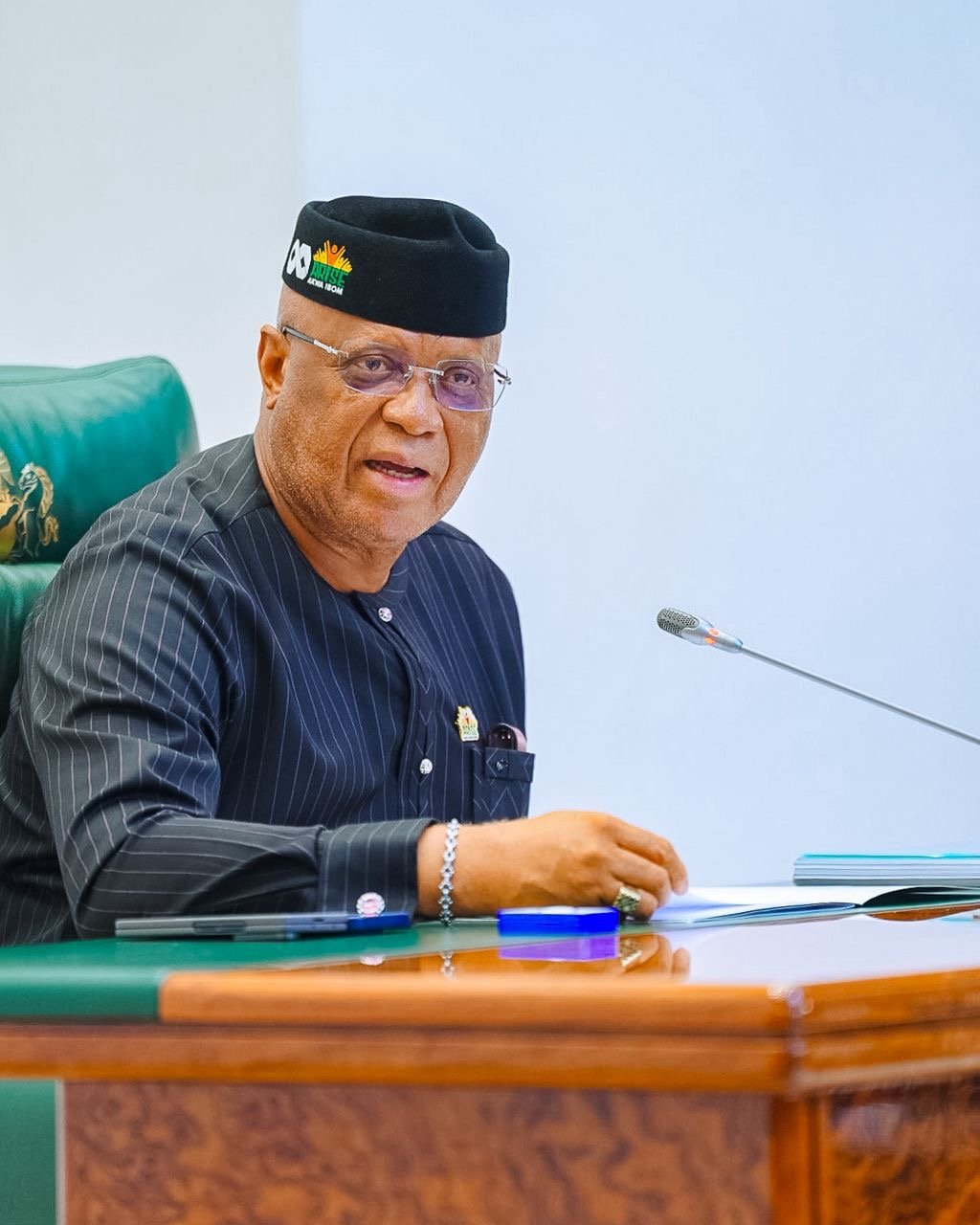










Minister Nyesom Wike.
By Sam Akpe
Confused.Undecided. Disordered. Manipulated. These words fittingly depict the current state of affairs and conscience of the Rivers State House of Assembly in its impeachment plot.
The swords are already drawn. The atmosphere is toxic with the smell of blood and screams of agony. There is an aberration in the ambiance, and justice is crying for help!
The previously calm waters of Rivers State have surged over their banks. Streams are submergingplateaus. What shall we tell our children!
Several generations of Nigerians would find it hard to explain why a sitting state governor, elected by thousands of citizens, was subjected to impeachment by a few self-centered individuals—an act masterminded by one man.

Governor Siminilaye Joseph Fubara is facing impeachment threat, not because of any criminal offence or intolerable misdemeanour. The threat is a product of political arm-twisting aimed at panicking him into keeping a secret agreement.
The governor is up against a legislative cabal with a stockpile of poisonous intents. They have found in him someone with restrained powers, who has refused to shrink in the face unspeakable intimidation.
Impeachment is a creepy democratic phraseology that is hardly executed, because of the complexities of its rules, which are scarcely followed.
The road to impeachment is generally narrow and thorny. In Nigeria, more politics than legality is the chief weapon for and against impeachment.
As a democratic tool for checks and balances, impeachment has often been turned into a sword, which, when dangled even before the innocents, troubles them into submission.
This ought not be so. As described by Laurence Tribe and Joshua Matz, impeachment is one of the few architectural cornerstones of the constitution in any democracy.
In Nigeria, no president has ever been impeached. Yes, state governors have been impeached and removed from office, but none of the procedures adopted for such impeachment was strictly constitutional—or legal. None!
If you know and are ready to diligently adhere to what the 1999 Constitution has established as conditions precedent in impeachment, not even the most manipulated lawmakers will waste their time trying to impeach a sitting governor.
In the specific case of Rivers State, the question hangs: should Fubara be impeached over disputes arising from a breach of a surreptitious personal bargain with no foundation in law—an agreement that voters are not privy to?
In summary, if each of the lawmakers in Rivers State House of Assembly were asked why he or she wants to impeach Governor Fubara, what constitutional reasons would we expect?
Wait a minute! You want to impeach Fubara on allegations of non-budgetary expenditure, when you, in breach of the 1999 Constitution, neglected your duties of passing Appropriation Bills for the state?
The implication here is that these lawmakers are guiltier than Fubara in the very act that spurred the impeachment threat!
In actual sense, every member of Rivers legislature deserves to be impeached for refusing to perform their constitutional function of receiving and passing Appropriation Bills which is their primary duty.
This act equals deliberately throwing the state into a circumstance of ungovernability. It amounts to calculatingly inviting anarchy instead of ensuring peace and development by passing a bill that would empower it.
In actual sense, answering the question as to whether Fubara deserves impeachment would demand examining the issues that constitute impeachable offences in a democracy. Let’s go down memory lane.
On February 25, 1868, Thaddeus Stevens, an American Congressman from Pennsylvania was carried aloft into the Senate Chambers of the United States Congress.
He had to be carried in his chair into the chamber, according to Brenda Wineapple, because he was debilitated by sickness and could hardly climb the steps leading to the hallowed chamber.
The physical disadvantage however did not deter his principled determination to present to the Senate the decision of the House concerning the impeachment of President Andrew Johnson
The House had 24 hours earlier overwhelmingly voted 126 against 47 in favour of the impeachment of the president. It was the first in American history.
When he finally stood, facing the American grandmasters of legislative business, Stevens declared: “We do impeach Andrew Johnson, President of the United States, of high crimes and misdemeanours in office.”
Did you notice the phrase: “high crimes and misdemeanours?” Article 11, Section 4 of the United States Constitution which have gone through a few amendments by now, stipulates grounds for impeachment of the president.
It states in part that such impeachment shall be based on “treason, bribery, or a high crime or misdemeanour.” That means they had indisputable constitutional reasons to impeach their president.
In the United States, impeachment is a serious business. Wineapple confirms in her analysis that at that stage (1868) in American history, impeachment was the democratic equivalent of a regicide—death sentence on a ruler.
One of America’s founding fathers, Benjamin Franklin, is cited as saying that without impeachment, outright murder was the other option to remove a scoundrel from public office. Impeachment was considered more decent.
Johnson was a reckless racist who hated black Americans deeply. He was also accused of abusing public trust and violating laws passed by the legislature. Still, the Senate did not sack him from office.
Unlike what is unfolding now in Rivers State, his impeachment by the House of Representatives was not based on personal agreement between a governor and a godfather!
Impeachment is not a cheap democratic avenue to inflict punishment or settle personal scores against a stubborn political partner.
Impeachment is what Alexis de Tocqueville calls, “the most formidable weapon that has ever been placed in the grasp of the majority.”
Here, ‘majority’ is the keyword. Impeachment is not a political spear created to be used by a political godfather whenever he feels offended by his godson.
An impeachment must receive the consent of the majority of voters, represented by the lawmakers, after due consultation.
Governor Fubara seems to be facing the same kind of impeachment threats imposed on President John Tyler in 1842. Tyler’s offence was that he had a mind of his own on certain issues, and also vetoed unpopular bills.
It was Congressman John Quincy Adams who moved against Tyler with an impeachment threat. As observed by legislative historians, the lawmakers simply needed to override Tyler’s vetoes and not attempt to impeach him.
The constitution does not consider refusal to sign a bill as a high crime or even misdemeanour—the same way a breach of self-centered agreement between a godfather and godson in Rivers State is not a criminal offence worth an impeachment.
Needless to say, that the moves against Tyler failed flat due to certain political maneuvering and legal bulwarks. With a vote of 127 to 83, the impeachment moves died in the House of Representatives.
What the Rivers State lawmakers and their godfather are trying to do to Fubara is an equivalent of what Gerald Ford attempted against Justice William Douglas in 1969, which Maxine Waters echoed against Donald Trump in 2017.
Waters toed the line of Ford’s 1969 rhetoric to the effect that impeachable offences are whatever majority of lawmakers consider them to be at any specific time in history.
Such a definition has no place in law. It is an empty construct of a few desperate individuals who feel that their lawmaking status has turned them into gods.
Every impeachable offence must be unambiguously stated in the constitution or perhaps interpreted by the Supreme Court—where needs be! A breach of a bandied cloak-and-dagger agreement will fall flat before the supremacy of the constitution.
Those bent on impeaching Fubara, in the words of Alan Dershowitz, are running roughshod over fundamental issues that would demand interpretation in law.
The slapdash approach to the entire drama is worrisome, because as observed by Dershowitz, impeachment and removal from office of an elected public officer is a momentous event, not a mere emotional outburst.
Yes, every impeachment has overflowing elements of politics, but if the formal process associated with it, states Dershowitz, “is to have legitimacy, it must be done in strict compliance with the constitution.”
The mundane tales that constitute the hidden articles of impeachment was reportedly addressed to a certain Madam Fubara. Confusion out of desperation!
At a point when it was assumed that sanity had returned to the House as co-conspirators renounced their complicity, top officers of the House began blustering with unrestrained temerity.
They insisted that Fubara must be impeached irrespective of any contrary judicial pronouncement.
I still believe there is no convincing constitutional reasons for this political commotion. The lawmakers are merely demonstrating questionable loyalty to a star power symbolised by Minister Nyesom Wike.
However, my opinion is that the pronouncement by the court in Port Harcourt is equally a golden opportunity for the minister and his team to free themselves from negative history by withdrawing from this pathway.
Minister Wike, whom I used to know personally, can become a political hurricane or the strong man of Rivers politics without a process that is fast becoming an assault on democracy.
The minister’s reputation as a success story during his governorship of Rivers State is almost at the point of being rubbished by his assumed endorsement of the ugly incident that is building up in Rivers State
Pulling down this already cracked walls of impeachment might be Wike’s last chance to redeem his already receding post-governorship rapturous applause.
My thinking is this, Wike and his obedient lawmakers do not need to put Rivers State through this avoidable political nightmare. It is unnecessary and obviously self-centered.
After a bruising youth militancy of the early 2000s preceded by a military occupancy of the state in the 1990s, Rivers people do not deserve this looming personalized political mishap.
If every ambitious politician with the right connection, loyal foot soldiers and heavy financial resources chooses this path, Nigeria would be a complete political wreck.
Finally, in my last intervention, I proposed a roundtable. I still stand by it. That is where every war starts and that is where it usually ends.
Impeachment should not be employed as a tool for settlement of political conflict. It could generate troubling and unpredictable consequences—with a destructive ending.
Akpe is a Journalist and writes from Abuja.